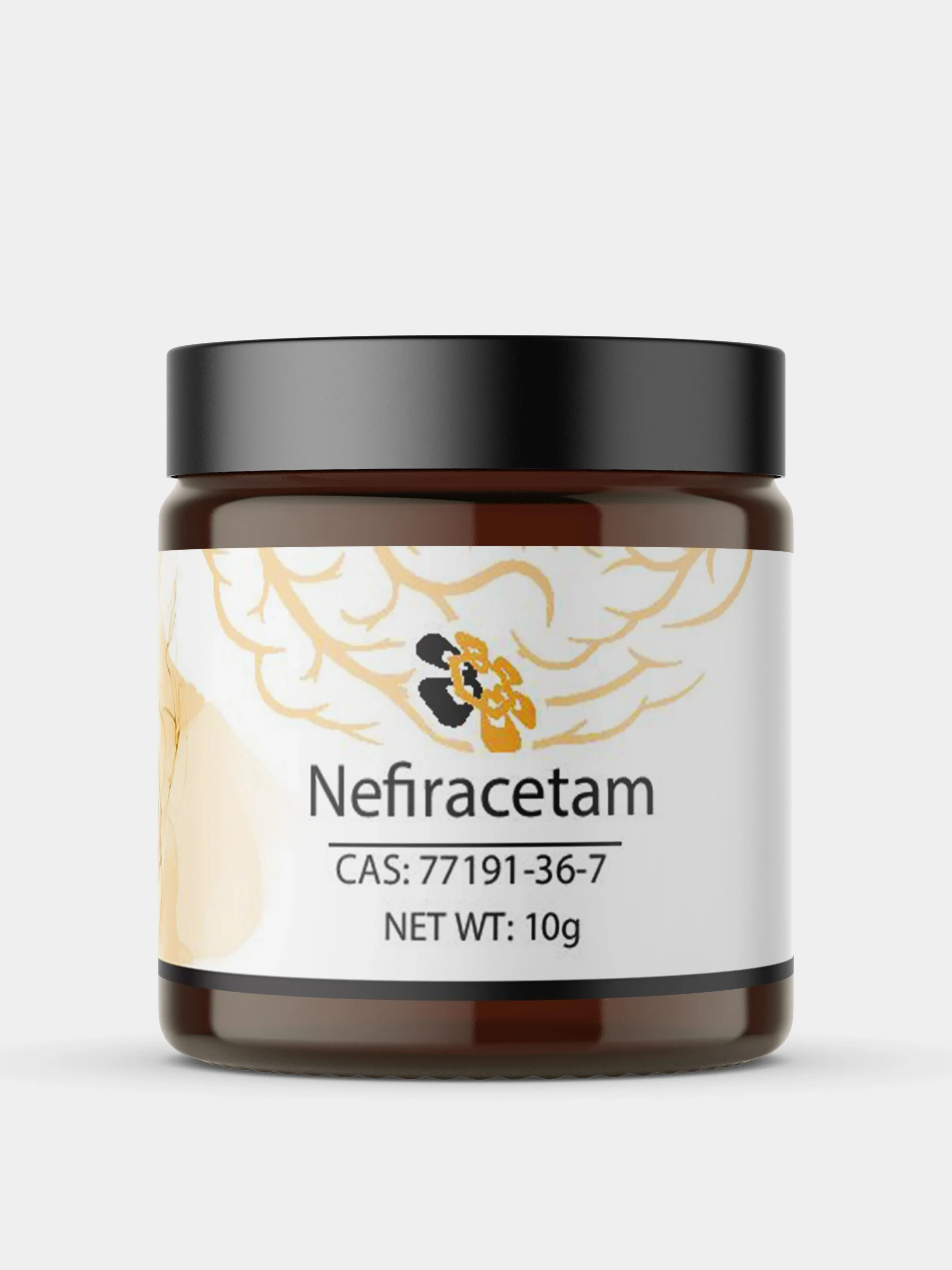
Nefiracetam
From €39.80
Nefiracetam is a synthetic nootropic compound belonging to the racetam family, researched for its potential to enhance memory, learning, and cognitive function. It is also investigated for its neuroprotective properties and potential anxiolytic effects through modulation of neurotransmitter systems.
For a more detailed description and lab analysis, please see the sections below.

SAFE & SECURE CHECKOUT


LAB TESTED
100% SATISFACTION GUARANTEED

Description
Nefiracetam – Powder
Every so often, a molecule comes along that teaches neuroscientists something important even though it never becomes a medicine. Nefiracetam is one of those molecules. In laboratory neurons, it does something genuinely elegant: it makes the precise receptors your brain uses for learning and memory more responsive to the signals they already receive — at concentrations so small they are hard to visualize. It was developed in Japan as a serious medicine for dementia and the after-effects of stroke. It reached the gates of approval, and then it stalled.
This article explains, in plain language, what nefiracetam is, how it works, what it did (and didn’t do) in people, how the body handles it, and why its story matters. It is an educational overview, not a recommendation — and it is written to be read and understood without a neuroscience degree.
1. At a glance
| Aspect | Detail |
|---|---|
| What is it? | A synthetic molecule in the “racetam” family, designed to influence cognition |
| Chemical identity | N-(2,6-dimethylphenyl)-2-(2-oxopyrrolidin-1-yl)acetamide (C₁₄H₁₈N₂O₂, 246.3 g/mol) |
| Chemically speaking | A cyclic derivative of GABA — the brain’s main “brake” chemical — folded into a ring |
| Development codes | DM-9384 (early research), DZL-221; proposed Japanese brand name Translon® |
| Original developer | Daiichi Seiyaku (now Daiichi Sankyo), Japan |
| Discovery era | First studied in the late 1980s |
| Intended use | Alzheimer’s-type and vascular dementia; consequences of stroke |
| Regulatory outcome | Never approved in Japan, the US, or Europe |
| Strongest human signal | Reduction of apathy after stroke at a high dose (one trial, not replicated) |
2. What it is, chemically
All drugs in the racetam family share the same backbone: a five-sided ring of atoms called a pyrrolidinone (or pyrrolidone) ring. That ring is, in essence, the neurotransmitter GABA — gamma-aminobutyric acid, the brain’s primary calming signal — folded into a loop.
Different racetams then attach different “handles” to this shared core. Nefiracetam’s handle is a 2,6-dimethylphenyl group — a small benzene-type ring carrying two extra carbon atoms. This seemingly minor decoration does two things:
- It makes nefiracetam much more fat-soluble than its grandparent, piracetam, so it partitions readily into the fatty membranes of brain cells.
- It changes which proteins the molecule interacts with, giving nefiracetam a distinct biological profile among the racetams.
Making it in the lab is conceptually simple. Starting materials — a compound called 2,6-xylidine (a building block related to benzene) and the ring 2-pyrrolidinone — are linked together through two straightforward reactions. Published syntheses report high yields (around 90%), which is part of why the molecule was attractive to industrial chemists.
3. A brief history
Nefiracetam’s timeline reads like a compressed history of 1990s–2000s dementia-drug development:
| Period | Event |
|---|---|
| Late 1980s | Daiichi scientists synthesize DM-9384 and show it improves learning and memory in rats with induced amnesia |
| Early 1990s | Animal (mice, rats, dogs, monkeys) pharmacology and toxicology programs run; first human dosing in Japan |
| 1990s | Japanese trials in cerebrovascular disease and vascular dementia; promising early, industry-run results |
| 1999–2001 | A large multi-site US trial in post-stroke depression (with an apathy sub-analysis) runs |
| 1999–2002 | An NIH-funded phase II trial in Alzheimer’s disease runs in the United States |
| February 2002 | Daiichi withdraws its Japanese marketing application for the proposed anti-dementia drug Translon®, citing insufficient efficacy |
| 2003–2009 | Toxicology papers explain why dogs were uniquely sensitive; a 2009 paper reports the apathy finding |
The pivotal moment is February 2002. Japan’s regulator had asked Daiichi to repeat its phase III studies under newer guidelines because earlier efficacy data weren’t convincing enough. The repeated trials did not demonstrate clear efficacy, and the company withdrew. Development in other regions continued for a while — at different points the drug was in phase II in the US and phase III in Europe, and awaiting approval in China — but it never crossed the line anywhere.
4. A 60-second primer on brain signaling
To understand what nefiracetam was trying to do, three mental pictures help.
- Neurons are houses. The brain contains billions of them, connected across tiny gaps called synapses.
- Neurotransmitters are couriers. When one neuron wants to talk to the next, it releases a chemical messenger — acetylcholine, glutamate, GABA, dopamine, and dozens more — that drifts across the gap.
- Receptors are doorbells. On the far side, the messenger rings a protein “doorbell.” If the ring is loud enough, the receiving neuron responds and passes the message along.
Learning and memory, at the cellular level, involve turning specific doorbells up so that frequently used pathways respond more strongly over time. This strengthening is called long-term potentiation (LTP) — picture a footpath across grass slowly becoming a paved road because it keeps getting walked on.
The appealing idea behind nefiracetam is that it doesn’t flood the brain with extra couriers (which can cause side effects). Instead, it appears to turn up the sensitivity of particular doorbells, helping the brain do more with the signals it already produces.
5. How it works, cell by cell
Most of the fine-grained brain-cell work comes from the laboratory of pharmacologist Toshio Narahashi at Northwestern University, using a technique called patch-clamp recording — essentially a tiny microphone that listens to how receptors respond, one channel at a time.
5.1 It turns up the “learning signal”: acetylcholine and nicotinic receptors
Acetylcholine is a messenger central to attention, learning, and memory — and among the first systems to deteriorate in Alzheimer’s disease.
Acetylcholine rings several doorbells, one type being the nicotinic receptor (named only because nicotine happens to activate it, too). Nefiracetam makes a common brain subtype, the α4β2 nicotinic receptor, respond more strongly when acetylcholine arrives. In rat neurons, this boost peaks at extremely low concentration — the nanomolar range.
To grasp how small a nanomolar is:
A nanomolar is on the order of a single grain of table salt dissolved in a bathtub of water. Nefiracetam produces some of its receptor effects at these vanishingly small concentrations.
Three important nuances keep this honest:
- The curve is bell-shaped. There’s a “Goldilocks” optimum. Too little does nothing; there’s a sweet spot; and more actually works less well. On paper, that makes dosing inherently finicky.
- The response is biphasic. In some expression systems, nefiracetam slightly depresses the receptor at very low (sub-micromolar) concentrations and enhances it at higher (micromolar) concentrations — two opposite effects at different concentrations, again pointing to complexity.
- Species and cell type matter. In at least one system using human receptor subunits expressed in cultured cells, the effect differed from that seen in rat neurons — a textbook reminder that dish biology doesn’t always translate to people.
5.2 It sharpens the memory-forming “coincidence detector”: NMDA/glutamate
Glutamate is the brain’s main “gas pedal” — its primary excitatory signal. One glutamate doorbell, the NMDA receptor, is famously important for memory because it works as a coincidence detector: it opens fully only when a neuron is already partly “warmed up” and glutamate arrives at the same moment. That is the cellular basis of “neurons that fire together, wire together.”
The NMDA receptor has a “co-pilot seat” called the glycine site. Nefiracetam interacts with that site and makes the receptor respond more strongly — again, in the nanomolar range.
5.3 It helps release the couriers: calcium channels
For a neuron to release its neurotransmitters, a small flood of calcium must rush in through pores called calcium channels. Calcium is the “go” signal that tells the neuron to fire off its couriers.
Nefiracetam boosts the activity of two specific kinds — L-type and N-type calcium channels (but not T-type) — in neurons. More calcium entry means more neurotransmitter release. Through this route, nefiracetam was shown to produce a long-lasting (more than 4 hours) “LTP-like” strengthening of signaling in the rodent hippocampus, the brain’s memory headquarters.
5.4 It interacts with the brain’s “brakes”: the GABA-A system
Neatly, for a molecule that boosts memory circuits, nefiracetam also interacts with the major inhibitory system.
GABA is the brain’s main “brake pedal,” calming activity through GABA-A receptors. Nefiracetam binds the GABA-A receptor with high affinity (an IC₅₀ around 8.5 nanomolar in binding assays) and shifts the receptor’s behavior. In patch-clamp recordings, it causes a transient enhancement of GABA’s signaling at low GABA concentrations, while accelerating the receptor’s “switching off” (desensitization) at high concentrations.
Why this matters: a well-timed nudge to inhibitory circuits can help rebalance networks that have become over- or under-active after injury — and it likely also contributes to nefiracetam’s surprising anticonvulsant properties (see below). Consistent with a GABA-related effect, nefiracetam also reversed chemically induced amnesia in mice caused by drugs that block GABA-A receptors.
5.5 Bonus finding: it resembles an anti-seizure drug
In animal seizure models, nefiracetam inhibited electroshock-induced seizures — the same screening test that predicted the usefulness of drugs like phenytoin and carbamazepine — at non-toxic doses. Its anticonvulsant profile roughly paralleled those older drugs while showing a wide safety margin in those tests.
This is a lovely biological irony: nefiracetam’s structural cousin levetiracetam (Keppra) did become an approved medicine — not as a memory pill, but as an anti-seizure drug. The racetam “surname” is a chemical family name, not a promise of brain-boosting.
How can one small molecule nudge so many different receptors? The answer is that nefiracetam doesn’t behave like a simple “key in a lock.” Instead, it engages second-messenger cascades — chains of relay molecules inside the cell that amplify and distribute a signal.
Specifically, the evidence points to:
- Enhancement of nicotinic receptors → carried by a stimulatory G-protein (Gs) and protein kinase C (PKC).
- Enhancement of N/L-type calcium channels → carried by inhibitory G-proteins (Gi/Go) and a cAMP / protein kinase A (PKA) pathway.
- GABA-A receptor modulation → involves PKA and interactions with Gi/Go proteins.
In plain language: nefiracetam pulls several different intracellular levers (PKA, PKC, G-proteins), and those levers then adjust the sensitivity of the receptors. That broad reach is part of why the molecule looked so versatile in the lab — and also part of why its net effect in a whole organism is so hard to predict from a single dish experiment.
Putting the mechanism together
The laboratory story is coherent and genuinely beautiful: Nefiracetam makes today’s learning-relevant receptors more responsive to the signals already present, boosts the release of those signals, and nudges inhibitory brakes in a way that can help rebalance injured or aging circuits — while showing protective effects in animal models of brain injury. That is a compelling design on the whiteboard. The challenge, as always, came when it met a whole living human being.
6. What it did in animals
Before human trials can begin, a compound must first show promise in animal models. Nefiracetam cleared that bar impressively.
Researchers can impair a rodent’s memory in many ways — with drugs, with interrupted blood flow, or with molecules tied to Alzheimer’s disease. Nefiracetam reversed or reduced memory deficits induced by:
- Scopolamine (which temporarily blocks acetylcholine, mimicking a core feature of Alzheimer’s)
- GABA-A blockers (bicuculline, picrotoxin) — reversing amnesia while notably not blocking seizures
- Ethanol and chlordiazepoxide (a benzodiazepine)
- Cycloheximide (which blocks new protein synthesis)
- Carbon monoxide exposure (a model of hypoxic brain damage)
- Cerebral ischemia (stroke-like blood-flow interruption)
- β-amyloid (Aβ₁₋₄₂) infusion — a direct infusion of the peptide that forms plaques in Alzheimer’s disease
In the β-amyloid model, giving rats nefiracetam by mouth (1–10 mg/kg) improved spontaneous alternation, spatial working/reference memory in a water maze, and passive-avoidance retention — while increasing the activity of choline acetyltransferase (the enzyme that makes acetylcholine) and boosting dopamine turnover in the cortex.
The honest caveat, familiar to every pharmacologist: rodent amnesia models are a long way from human dementia. Countless drugs have triumphed in exactly these tests and failed in people. Animal success is necessary, not sufficient.
7. What happened in humans
Here is where the story turns. The human evidence was nowhere near as clean as the petri dish.
7.1 Early Japanese trials in vascular dementia (1990s)
The first human experience came in Japan, focused on vascular dementia — cognitive decline arising from impaired blood flow to the brain. Industry-run, double-blind, placebo-controlled 8-week trials reported that nefiracetam outperformed placebo and was at least as effective as idebenone (another cognitive drug of that era) at improving cognition and psychiatric symptoms. Open-label extensions suggested maintained benefits over 2–12 months.
The caveats: these were mostly older, company-sponsored studies using outcome measures that modern reviewers would consider soft — and the effect was never convincingly re-established in independent, rigorous follow-up trials.
7.2 Alzheimer’s disease — the pivotal test fizzled
In the US, an NIH-funded (NINDS) phase II trial (NCT00001933) tested nefiracetam against placebo in about 50 patients with mild-to-moderate Alzheimer’s disease, running from 1999 to 2002. The trial included neuropsychological testing across 20 weeks. It did not deliver the kind of clear, durable, clinically meaningful cognitive benefit that regulators require — and, critically, it was concurrent with the safety cloud described in Section 9.
In February 2002, Daiichi withdrew its Japanese application for Translon® for dementia, citing insufficient efficacy in the repeated phase III trials. The Alzheimer’s disease program was, in effect, over. Drug databases list its dementia development status simply as “discontinued.”
7.3 A surprising bright spot: apathy after stroke
The single most interesting human result came later, in 2009, and it wasn’t about memory at all.
A double-blind, placebo-controlled, multi-site study (28 sites, run 1999–2001) examined stroke survivors with major depression. As a secondary analysis, the authors looked at the 70 of 137 patients who also met criteria for apathy — a syndrome of lost motivation, initiative, and emotional responsiveness that commonly follows brain injury.
The findings:
- 900 mg/day produced a significantly greater reduction in Apathy Scale scores over 12 weeks than either placebo or the lower dose.
- 600 mg/day did not differ significantly from placebo.
- Remission (defined as a 75% drop in apathy score) occurred in 4 of 22 patients on 900 mg — versus 1 of 26 on 600 mg and 0 of 22 on placebo.
Interestingly, depression scores improved equally in all groups. The effect, if real, was on drive and motivation, not on mood. That is a mechanistically plausible, clinically meaningful-looking signal. But it is also one moderately sized, secondary analysis, never robustly replicated, powered originally for depression rather than apathy. It was not enough to bring the drug back.
7.4 Other human observations
Electrophysiology work in eight patients with vascular dementia found that 450 mg/day shifted the brain’s P300 event-related potential — an electrical signature of attention — toward normal values, alongside performance improvements. This is consistent with the mechanistic story, but it is a small, preliminary signal.
8. How the body handles it (pharmacokinetics)
This is useful, concrete biology — and much of it comes from early volunteer studies in Japan.
- Absorption: Nefiracetam is taken by mouth and absorbed quickly, reaching peak blood levels within roughly 1.5–2 hours.
- Half-life: Its elimination half-life is 3–5 hours — meaning the body clears half the dose every few hours. It requires repeated daily dosing to maintain levels.
- Dose-proportionality: Blood levels scale linearly with dose across a wide range (studied from 10 mg up to grams), a convenient property for a drug developer.
- Excretion: Only about 5% leaves the body unchanged in urine. The rest is metabolized. All together, about 43% of a dose is recovered in urine within 24 hours as the parent drug plus three measured metabolites.
- Metabolism: The liver does the heavy lifting. The main metabolite is 5-hydroxynefiracetam, produced chiefly by the enzyme CYP3A4 (with a minor contribution from CYP1A2). Other metabolites include several hydroxylated forms and a pyrrolidine ring-scission product.
- Food: A meal delays absorption but does not meaningfully change overall exposure.
The practical significance of the 3–5-hour half-life: steady-state levels build up over about a week of regular dosing, and the drug is cleared relatively quickly once stopped. It is a short-acting compound by design.
9. Safety and toxicology: why regulators paused
This is the most consequential part of the story — and worth understanding with nuance rather than alarm.
9.1 What dogs showed
In a 52-week study in beagle dogs, the target organs for toxicity were unmistakeable: the kidneys and the testes.
- At 90 mg/kg/day, dogs developed signs of kidney stress — rising blood urea nitrogen and creatinine, large volumes of dilute urine — and microscopic damage to the renal papilla (the inner part of the kidney responsible for concentrating urine), the collecting ducts, and scarring of kidney tissue.
- The testes showed reduced sperm production, with fewer or absent sperm in the epididymis.
- At 30 mg/kg/day, changes were minimal and considered “equivocal” in one animal.
- At 10 mg/kg/day, no treatment-related effects were seen — defined as the no-effect level.
In separate higher-dose studies (300 mg/kg/day), dogs developed hemorrhagic bladder lesions with blood and protein in the urine early on, progressing to kidney papillary necrosis (death of kidney tissue) by around 8–11 weeks — and some animals died at weeks 10–11.
Single high oral doses were not dramatically toxic on their own (LD₅₀ around 2,000 mg/kg in mice and ~1,200 mg/kg in rats, with sedation-like CNS signs), meaning the concern was cumulative organ damage with long-term dosing, not acute poisoning.
9.2 Why dogs, specifically? The species puzzle
Crucially, the toxicity was not uniform across species:
- Rats developed testicular toxicity only at very high doses (around 1,500 mg/kg/day for 4 weeks), apparently via a transient drop in testicular testosterone. They showed no testicular effect at 480 mg/kg/day for 13 weeks or 300 mg/kg/day for 52 weeks.
- Monkeys showed no testicular toxicity at 120 mg/kg/day for a full year.
- Dogs were uniquely sensitive — at doses far below those tolerated by rats and monkeys.
Researchers traced much of this to a specific breakdown product, metabolite M-18. In dogs, M-18 accumulates to strikingly higher concentrations in the renal papilla than in rats or monkeys. M-18 disrupts the barrier function of bladder-lining cells in culture and inhibits prostaglandin synthesis in dog kidney tissue — a combination that plausibly explains the bladder and kidney damage. In other words, the molecule’s own metabolism produced a toxic by-product that concentrated in dog kidneys at a rate other species did not replicate.
This is a genuinely important scientific point: species differences in drug metabolism can create safety findings in one species that do not necessarily predict trouble in another. But in regulatory science, “dogs are special” is a defense that must be proven, not assumed — and it never fully cleaned the slate.
On the other standard toxicology panels, the news was unremarkable: nefiracetam was not mutagenic in standard assays, not carcinogenic in mice and rats, and not teratogenic in rats and rabbits.
9.3 What the human trials reported
In the (comparatively short) human trials, reported adverse effects were infrequent and mostly gastrointestinal (nausea-type symptoms), with no urinary or reproductive effects flagged. Phase I dosing in Japan likewise found no evidence of the dog-type toxicity.
The fair summary is a balanced one: The human data, such as they are, were reassuring but brief. The dog data were serious and reproducible, but species-specific, with a plausible metabolic explanation.
Related products
Bemethyl Free Base
From €44.80

Memantine HCL
From €38.90

Noopept
From €22.80

NSI-189 Phosphate
From €29.80
Piracetam
From €29.80

PRL-8-53
From €24.11
Uridine
From €24.80Lab Analysis

Chemical Informations
| Property | Details |
|---|---|
| Compound Name | Nefiracetam |
| CAS Number | 77191-36-7 |
| Molecular Formula | C14H18N2O2 |
| Molecular Weight | 246.31 g/mol |
| IUPAC Name | N-(2,6-dimethylphenyl)-2-(2-oxopyrrolidin-1-yl)acetamide |
Storage Conditions
| Property | Details |
|---|---|
| Temperature | Store at 20-25°C (room temperature) |
| Environment | Cool, dry place |
| Protection | Keep away from moisture and light |
| Form | Powder for research use |
Related products

9-me-bc
From €49.90
Bemethyl HBr
From €94.80
Bromantane
From €34.90
Memantine HCL
From €38.90